What it shows
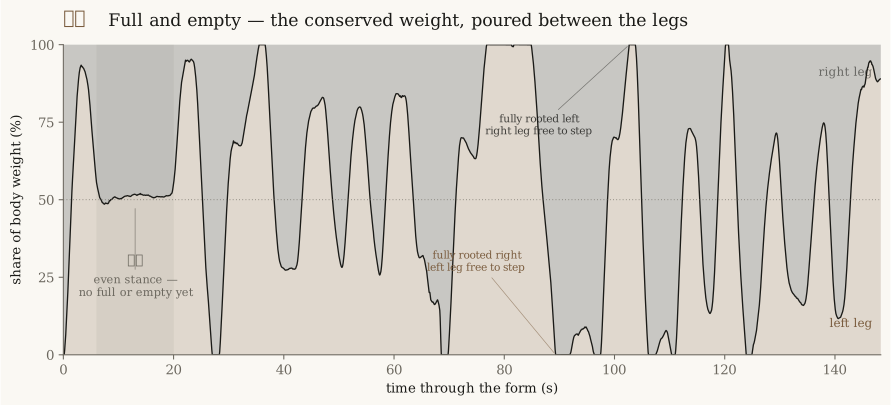
The classics name the weighted leg full (實) and the unweighted leg empty (虚), and insist the two are one relation, not two things. Here that relation is measured. The two bands are the share of body weight on each leg; they always sum to the whole, so the figure draws a conserved quantity being placed, not created or destroyed.
Three things read straight off it. The opening holds near 50/50 for the first fourteen seconds — the even, undifferentiated stance, wuji before the weight has been given anywhere. Then the form begins and the boundary pours: roughly twenty deep, near-complete transfers from one leg to the other. And the transfers are near-total — not the shallow 55/45 of walking, but the full commitment that frees the empty leg to step. To root is to place fullness here so that emptiness — and therefore freedom to move — is available there.
Method
Real motion capture, with no model of “tai chi” baked in: the CMU 12_04 trial (a recorded tai chi form) → forward kinematics to 3D joint positions → a whole-body center of mass via Winter’s segment masses → a quasi-static estimate of how weight shares between the feet from where the center of mass sits over its base. The full derivation, provenance, and license live in the figure’s provenance.json sidecar and the taiji_research pipeline.
The estimate is quasi-static — it reads load from geometry, valid because tai chi moves slowly enough that accelerations are small. It is not measured ground-reaction force, and it is labeled as such wherever it appears.
Journal
- 2026-07-19 — Pulled the CMU tai chi trial (it fetches cleanly over HTTP; the host’s HTTPS certificate is broken). Forward kinematics rendered an anatomically correct body on the first pass — the derivation chain held.
- 2026-07-19 — An early exploratory version mislabeled the leg segments by one bone: it used the femur’s distal end — the knee — as the thigh’s proximal point. Rebuilt the pipeline against anatomical, named joints so that class of error can’t recur. The figure’s story was unchanged, which confirmed it rests on the robust horizontal center-of-mass signal, not the details of the leg model.