Wuji → Taiji: The Foundation
Stillness, differentiation, and broken symmetry — the opening move of taiji, read as physics.
Every form in this art begins from the same place, and it is not a posture. Before the hands rise, before the weight settles into one leg, there is a state the classical texts insist on naming: a stillness that is not yet anything in particular. To take that state seriously — not as mysticism but as a description of a physical condition — is the whole purpose of this first essay. The old vocabulary and the language of mechanics are pointing, from different centuries, at the same shape.
Wuji — the ridgepole absent
無極 wújí, “without ridgepole” is the state before distinction. Jou Tsung Hwa opens his account of the art here, with the undifferentiated potential from which everything later unfolds. The literal sense of the characters is telling: no ridgepole, no beam laid across the top that would let you say this side from that side. Nothing is yet high or low, full or empty, left or right. The state has no preferred direction because it has no direction at all.
There is a clean physical picture for this. Imagine a ball resting at the bottom of a perfectly round bowl, or — better for what comes next — balanced on a surface that is flat and symmetric in every direction. The system sits at equilibrium. The net force on it is zero. And crucially, every direction it could move is equivalent to every other: nothing in the situation distinguishes north from south, forward from back. This is what physicists call a symmetric potential, and it is a strikingly apt rendering of what the classics mean by wuji. Not emptiness in the sense of nothing present, but balance so complete that no distinction has yet been forced to appear.
The practitioner standing in the opening stance is meant to inhabit exactly this: weight even, intention undirected, the body poised so that no movement is favored over any other. It is a real condition, not a poetic one. You can feel when you have it and when you have lost it.
The turn — symmetry breaks
Then something moves, and the world acquires sides. 太極 tàijí, “supreme ultimate” is the first distinction — the moment the undivided state gives rise to a division within itself. The weight shifts, however slightly, and now there is a full leg and an empty one, a substantial side and an insubstantial side. The ridgepole has been laid. From this single act of differentiation the entire grammar of the art follows.
The physical analogue is what is called spontaneous symmetry breaking. Return the ball to the very top of a smooth, symmetric hill. While it balances there, every direction is still equivalent — the situation is perfectly symmetric. But that balance is unstable, and the instant the ball begins to roll, it must roll somewhere. It picks a direction. The symmetry of the setup was real, yet the outcome cannot preserve it; the moment of motion destroys the equivalence of directions. Yin and yang are the two halves that appear precisely then — not before. They are the full and the empty that come into being together the instant the sameness is lost.
I want to be careful here, because this is where honest writing about this material usually stops being honest. I am not claiming that taiji is symmetry breaking, or that the classical authors were doing physics in disguise. They were not. What I am claiming is narrower and, I think, more interesting: the structure of the two ideas is the same. Both describe a symmetric, undistinguished state that becomes distinguished only through an act that cannot help but choose. It is an analogy of structure, and analogies of structure are worth having. They let a concept refined over centuries of bodily practice sit alongside one refined in the laboratory, and each sharpens how you see the other.
Yin and yang as complementary, not opposite
The most common misreading of yin and yang is to treat them as opposites at war — light against dark, hard against soft, one to be chosen over the other. That is not how the pair functions, in the classics or in the body. Yin and yang are complementary: each is defined only in relation to the other, and neither has meaning alone. The empty leg is empty only because the other is full. The rooted, weighted side earns its stability precisely by ceding mobility to its partner, which is light and free to move because it carries no load.
The cleanest way to see the relation is as a conserved quantity split between two reservoirs. Your weight is a fixed total; at any instant it is distributed between the two legs, and shifting more into one is exactly shifting less out of the other. Rootedness and lightness are not two competing virtues you must somehow maximize at once. They are the two ends of a single distribution, and the art is the continuous, deliberate management of how that fixed sum is apportioned. To root is not to become heavy everywhere; it is to place fullness here so that emptiness — and therefore freedom of movement — is available there.
Read this way, “yin and yang” stops being cosmology and becomes an accounting identity you can feel in your own legs. The total is conserved. The skill is in where you put it.
Stillness is not static
The classics ask the practitioner to seek stillness in motion and motion in stillness. It sounds like a paradox meant to be admired rather than tested. It is not. It is a measurable fact about how a human body holds itself upright, and the measurement has been made many times.
A person standing as still as they can is not still. The body is a tall mass balanced over a small base, and such a configuration is inherently unstable — left alone it would topple. It does not topple because the nervous system and the musculature are running a continuous correction, a low, ceaseless activity that never settles into rest. The standard way to see this is to record the center of pressure, the point on the ground through which the net upward force acts. In quiet standing that point is never stationary. It wanders in small, irregular excursions, a fraction of a centimeter this way and that, several times a second, for as long as the person stands. David Winter’s measurements make the pattern plain: postural sway is not noise to be eliminated but the visible trace of the control that keeps a fundamentally unstable body upright. The trace below is one such recording — a real person, standing still.
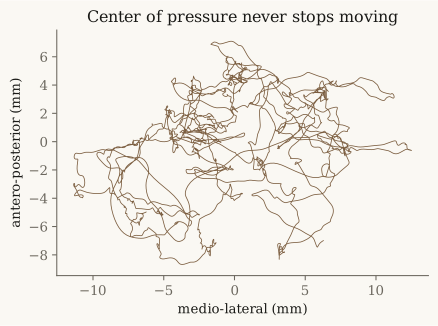
So the standing posture that looks like wuji made flesh — even, quiet, undirected — is underneath a storm of tiny distinctions being made and unmade many times a second. Stillness at the scale of the room is motion at the scale of the millimeter. The classics were not being mystical. They were reporting, in the only vocabulary they had, what a force plate now shows directly: that to stand still is to move constantly, and that the two descriptions are not in conflict.
Why this matters for the rest of the collection
Everything after this builds on the single move traced here — the pass from an undivided, balanced state into a differentiated, managed one. The essays that follow take up rooting as a real transaction with the ground, where the weight you place downward returns to you as ground reaction force; the way a conserved distribution of that force becomes the source of both stability and power; and, further on, a look at how walking robots and humanoid balance recover exactly these problems — McGeer’s passive walkers show that stable locomotion can fall out of mechanics alone, before any active control is added. The foundation is laid. What remains is to walk on it.